Sunday the 9th of November 2009 Burnie unveiled its new Makers Workshop.
At times a controversial project that attracted criticism at the cost, its appearance during construction, and just general lack of information displayed by those who didn't know the facts.
Its cost of around Au$5.35 million on completion belied what the actual cost to the rate payers really was. The figure in round figures was $850,000 of which some $450,000 was the insurance pay out for the catastrophic fire that destroyed the original building which was heritage listed. Furth er more wasn't the size of the new project that arose from the ashes some two years later.
At times a controversial project that attracted criticism at the cost, its appearance during construction, and just general lack of information displayed by those who didn't know the facts.
Its cost of around Au$5.35 million on completion belied what the actual cost to the rate payers really was. The figure in round figures was $850,000 of which some $450,000 was the insurance pay out for the catastrophic fire that destroyed the original building which was heritage listed. Furth
 er more wasn't the size of the new project that arose from the ashes some two years later.
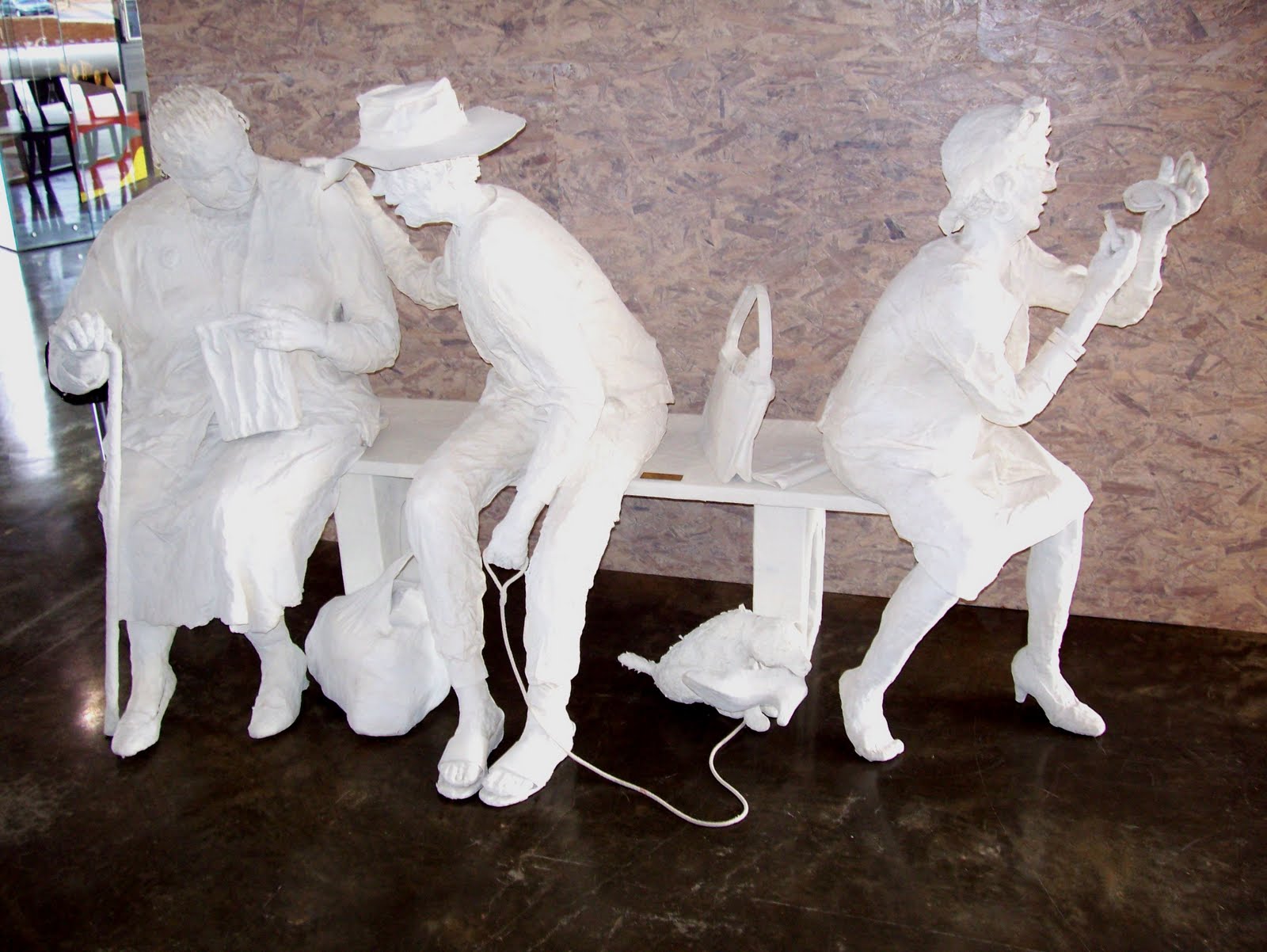
It is an interpretation centre, where enough information is available to whet the appetite of the visiting tourist, and it is the tourist it is aimed at as a marketing opportunity. It houses retailing of mementos, information about local crafts people, displays by these "Makers", the new home of Creative Paper, elements from the Pioneer Village Museum including the original Town Hall Clock in full working order, the Paper mache people, and as a major addition the first underground loader built by Dale B Elphinstone some 25 years ago just to name something of what you can expect to see. Included is the  Visitor Information Centre manned by competent volunteers who can offer advise on what to see, and where to find it, plus other information on Tasmania in general.
So accept an invitation to come and have a browse through this new facility, you will be amazed at what is there.
Consider these calculations.
Total cost to the community of Burnie $850,000Assuming that Burnie has 9000 rate payers, cost to each rate payer = $94.44. Now let us go another step and calculate the cost to each member of the community, man woman and child. Burnie's population of 19000 in round figures = $44.74 per head of population. Now let me take you one step further and reduce the figure by $450,000 paid out by the insurance received from the fire in 2007, again in round figures divided by the 9000 rate payer = $44.44 each. Divide again by the number of citizen of the municipality = $21.04 per head of population. A small impost for a public asset.
Some members of the community say that it will never pay for itself. I have yet to see any community funded project ever pay for itself whether it be a Town Hall, Arts & Function Centre, or in this case the Makers Workshop, but it will most certainly will be a public asset, and one the people of Burnie can be justifiably proud of in the foreseeable future.
 Quoted from the Burnie City Council media release 12th March 2009.
"BURNIE'S HISTORY HEART OF THE MAKERS WORKSHOP HUNDREDS of items showcasing Burnie s history are at the heart of the new Makers Workshop at West Park.With construction underway, the Burnie City Council s $5.35 million development will be one of the first of its kind in Australia.Project graphic designer David Lancashire has selected more than 200 items from the Pioneer Village Museum, which will support almost 40 stories depicting Burnie s history.Burnie Mayor Alvwyn Boyd said Mr Lancashire was amazed at the resources available and praised the Burnie community for its dedicati on to preserving its history. David said that there were very few communities that have done such a fantastic job of preserving its history, Mayor Boyd said.We have had and continue to have residents who go above and beyond the call of duty to showcase, protect and advance their city. Through the Makers Workshop, people just like this will be showcased and remembered through a significant collection of photos, objects and multi-media.The interpretative displays will come under eight major themes including Commerce and Industry, People and Pioneers, Global Connections, Agriculture and Environment, Innovators and Entrepreneurs, Paper and Paper Making, VDL Company and Port and the Pioneer Village Museum. Through these categories more than 40 different stories will be told.The facility will also have museum standard showcases and it is hoped that significant items from the State collection relating to Burnie s history can be sourced to form temporary exhibitions at the centre, Mayor Boyd said. He also said the facility would also provide locals and visitors with the unique opportunity of viewing the activity pods, which will act as studios for local artists.We've already had a number of local artists keen to get involved, Mayor Boyd said. "This will provide them with the opportunity to showcase their talents to a large, changing audience on a daily basis." There will also be paper-making activities, a gallery, café and a retail area, with the centre due for opening in October this year."
As a Volunteer at this new facility I can see nothing but benefits to the business houses of Burnie, tourism in the region, and dollars rolling in where the planners expected.
The Pioneer Village Museum Street Scape looks like getting a new lease of life (thank goodness) as this facility runs very close to the hearts and souls of the Citizens of Burnie. To see it closed would be equated to murder. It is the history of Burnie in the making from "Campsite to City" to quote the late Kerry Pink's book title. (If you haven't read it, ask for a copy of it from the Tasmanian State Library)
 Visitor Information Centre manned by competent volunteers who can offer advise on what to see, and where to find it, plus other information on Tasmania in general.
So accept an invitation to come and have a browse through this new facility, you will be amazed at what is there.
Consider these calculations.
Total cost to the community of Burnie $850,000Assuming that Burnie has 9000 rate payers, cost to each rate payer = $94.44. Now let us go another step and calculate the cost to each member of the community, man woman and child. Burnie's population of 19000 in round figures = $44.74 per head of population. Now let me take you one step further and reduce the figure by $450,000 paid out by the insurance received from the fire in 2007, again in round figures divided by the 9000 rate payer = $44.44 each. Divide again by the number of citizen of the municipality = $21.04 per head of population. A small impost for a public asset.
Some members of the community say that it will never pay for itself. I have yet to see any community funded project ever pay for itself whether it be a Town Hall, Arts & Function Centre, or in this case the Makers Workshop, but it will most certainly will be a public asset, and one the people of Burnie can be justifiably proud of in the foreseeable future.
 Quoted from the Burnie City Council media release 12th March 2009.
"BURNIE'S HISTORY HEART OF THE MAKERS WORKSHOP HUNDREDS of items showcasing Burnie s history are at the heart of the new Makers Workshop at West Park.With construction underway, the Burnie City Council s $5.35 million development will be one of the first of its kind in Australia.Project graphic designer David Lancashire has selected more than 200 items from the Pioneer Village Museum, which will support almost 40 stories depicting Burnie s history.Burnie Mayor Alvwyn Boyd said Mr Lancashire was amazed at the resources available and praised the Burnie community for its dedicati
 on to preserving its history. David said that there were very few communities that have done such a fantastic job of preserving its history, Mayor Boyd said.We have had and continue to have residents who go above and beyond the call of duty to showcase, protect and advance their city. Through the Makers Workshop, people just like this will be showcased and remembered through a significant collection of photos, objects and multi-media.The interpretative displays will come under eight major themes including Commerce and Industry, People and Pioneers, Global Connections, Agriculture and Environment, Innovators and Entrepreneurs, Paper and Paper Making, VDL Company and Port and the Pioneer Village Museum. Through these categories more than 40 different stories will be told.The facility will also have museum standard showcases and it is hoped that significant items from the State collection relating to Burnie s history can be sourced to form temporary exhibitions at the centre, Mayor Boyd said. He also said the facility would also provide locals and visitors with the unique opportunity of viewing the activity pods, which will act as studios for local artists.We've already had a number of local artists keen to get involved, Mayor Boyd said. "This will provide them with the opportunity to showcase their talents to a large, changing audience on a daily basis." There will also be paper-making activities, a gallery, café and a retail area, with the centre due for opening in October this year."
As a Volunteer at this new facility I can see nothing but benefits to the business houses of Burnie, tourism in the region, and dollars rolling in where the planners expected.
The Pioneer Village Museum Street Scape looks like getting a new lease of life (thank goodness) as this facility runs very close to the hearts and souls of the Citizens of Burnie. To see it closed would be equated to murder. It is the history of Burnie in the making from "Campsite to City" to quote the late Kerry Pink's book title. (If you haven't read it, ask for a copy of it from the Tasmanian State Library)
Lacos Cheese, and Hellyer Road Distillery, Emu valley Rhododendron Gardens, Ainsleigh Gardens, Guide Falls, T he Alpaca farm at West Ridgley will all be beneficiaries of what we can offer in our beautiful little city. The cruise ship passengers can't all be wrong. We just do not appreciate what we have in our "Patch of Paradise".
 he Alpaca farm at West Ridgley will all be beneficiaries of what we can offer in our beautiful little city. The cruise ship passengers can't all be wrong. We just do not appreciate what we have in our "Patch of Paradise".
Now a question for those of you who are going to visit the Makers Workshop.
What is the significance of the 127N on the wall, what does it stand for?
If you are a past employee of the APPM, Australian Paper, Paperlinx, or as it is now known as Tasmanian Paper and know the answer, please do not post a comment with its meaning.
It is interesting to note that the original underground loader is in pristine condition. I have been told on good authority that when Dale Elphinstone was asked if it could be put on display as is, he refused unless it was  looking brand new. What you see is months of work by his tradesmen fitted with new tyres, sandblasted and resprayed with epoxy enamel, new lights and drivable. Such is the man and his machines. A true "Maker" of Burnie.
 looking brand new. What you see is months of work by his tradesmen fitted with new tyres, sandblasted and resprayed with epoxy enamel, new lights and drivable. Such is the man and his machines. A true "Maker" of Burnie.
 As can be seen in the photo, the kids just love it.
Artists and Crafts people featured:
Jan Marinos. Paper maker and textile artist.
Darren Simpson. Paper maker.
Dean Jupp. Paper maker.
The three above mentioned can be seen at Creative Paper's workshop.
Kit Hiller. Painter and Print maker. Some of Kit's work can be seen hanging in the complex.
Rick Eaves. Photographer - Image maker.
Obie. The master image maker.
Maria Perez-Pulido. Violin maker.
Greg Ling. Wood craftsman and instrument maker.
Pam Thorne & Ruth Rees. The Paper people makers. Look around you when you enter, their work will amaze you.
Janine Morris. Fibre artist and basket weaver.
Janine Morris. Fibre artist and basket weaver.
Maudie Bryan. Glass artist and ceramic artist.
Anne Dunham. Glass artist and art teacher.
Mary Lewis. Glass bead maker.
Susanne McArthur, The Milliner. Hats and Fascinators for all occasions.
 From time to time Artists will have the opportunity to display their work in the Makers Workshop area. An example of this was the Digital Painting exhibition of 19 year old Penguin artist Jessica Turale who's exhibition opened Friday evening of the 13th Of November 2009. A very talented young lady.
 From time to time Artists will have the opportunity to display their work in the Makers Workshop area. An example of this was the Digital Painting exhibition of 19 year old Penguin artist Jessica Turale who's exhibition opened Friday evening of the 13th Of November 2009. A very talented young lady.
 Now while you are in the Makers Workshop feel free to ask for travel advise, places of interest to visit, and accommodation in the Burnie area. The Volunteers are well trained to assist you in making the correct decisions that will make your stay in Burnie one to remember.
Now that you have been around the displays, it's time to sit and relax with a coffee of your choosing in the Cafe area. Consider sampling the fine locally made pastries, or perhaps something else on the ever changing menu, Having been served, view the sights from the deck or though the plate glass windows. The views will astound you, take advantage of what you see and take photo's to remind you of the time you spent at the Makers' Workshop
7th August 2011 Notation added:
For the past few months there was much talk of National Foods the owners of the "Lactos" Cheese factory on Surrey Road Burnie spending big dollars to upgrade their plant. This has now been confirmed, plans submitted to the Burnie City Council for building and enviromental approval. A part of the up grade is the eventual closing of the onsite Cheese Tasting and retail shop. So now negotiations are talking place to relocate to the only place it should go to - "The Makers' Workshop".
One can only hope it is up and running before the next Cruise Ship season beginning in October 2011. I'm sure that this will be an added attraction to what is becoming an icon of Burnie. Whether you love it or hate it (the building), it is what is in the heart of it that counts, the people who work as Makers, volunteers, and paid staff that counts.
Makers Workshop. 2 Bass Highway, Burnie, Tasmania. 7320
Explore the possibilities, we did and still are.