Friday, March 19, 2010

The story of the "Forest to Paper" display case.

By John C Medwin, Volunteer Tourism Information Officer, and long term employee of the owners. APPM, North Broken Hill, and Australian Paper.

St Patrick’s day 17th March 2010 and the Irish must have blessed us as Tasmanian Paper authorised the removal of the display case to the Makers’ Workshop to go on display after renovation.

With the immanent sale or closure of the Tasmanian operations, I feared that the show piece would disappear forever. To someone’s shed and never be seen again, or maybe to the tip and destroyed as something of no value, or lastly, somewhere that the history of paper making industry in Burnie would be preserved.

The management of the Makers’ Workshop were advised that if they were at all interested, it was theirs after I had made the initial enquiries with Mr Chris Hind and his staff at Tasmanian Paper, Burnie. Our thanks go to him for having the foresight to allow its removal and the reason why, Now comes the renovations from its past dilapidated condition to one of pristine condition once again.

The cabinet with its glass sliding doors was built by George Butcher of Ulverstone, a Cabinet Maker employed by Associated Pulp and Paper Mills in the period between 1955 and 1960 although there is no record of employment past 1950 available. This time line was arrived at by speaking to the only carpenter employee still living Charles Whitton remembered it being made after the first continuous digester was operational. That project took place while I was an Apprentice Fitter and Turner at APPM. Naturally, there were others involved with its building. Bill Birchenough the pattern maker turned the cylinders on the "paper machine" from celery or huon pine. The railway truck and tray under the "Wet end" of the paper machine was the work on Mervyn "Speed" Atkinson a real character who was a plumber and sheet metal worker. The painted signs and original case varnishing were done by Allan Sutton foreman painter during those years. The original ticket writing came from the drawing office tracers which accounted for the symetrical lettering. Due to water damage these have all been replaced with computer gererated tickets.

The finished show case was then screwed to the western wall of the lift from the cutter room floor to the finishing room above where some 200 women were employed to sort and count the paper sent up from the cutters below. It was here that the mill tour guides recapped to visitors the paper making process. Over the passing years it fell into the various stages of neglect till now.

For those who view it will see that it depicts exactly how paper was made at that time. From the harvested forests at Hampshire and Surrey Hills administered by then Associated Forest Holdings Pty Ltd where the logs were then transported to Burnie Board and Timber, later to be known as Burnie Timber. (Both were subsidiary divisions of APPM.) It was then sawn into graded timber and the residue chipped and sent on a conveyor belt to the wood room at APPM to feed into the waiting digestors. Then the process of converting raw wood chips to a cellulose fibre without the other impurities began. The old static digesters were later replaced by the two Solman process continuous digesters developed by Dr Sloman at the Burnie Mill's Research Department.

The chips were cooked with a caustic soda solution in the super steam heated continuous digesters where the separation took place. The black liquor containing the unwanted impurities went to the rotary incinerators, evaporators, and lime kiln to recover the caustic soda, and carbon. The remaining fibre went to the bleach towers to be mixed with a liquid chlorine solution till the pulp became almost pure bleached white in colour. Brighteners were added at a later stage to achieve the high white of copy paper required in today's market place.
The Chlorine was produced using electrolytic cells where strong brine (salt water) NaCl + H2O passed over anodes and mercury to separate the Chlorine (Cl) from the sodium (Na). The resulting fluid was the bleaching agent required, and caustic soda (NaOH) used in the "cooking" of the chips. Today the milky chlorine fluid (ClO2) it is referred to as a dioxin and a pollutant.

The next stage of the process took the pulp to the refiners where it was ground to a finer consistency, alum, clay, and cationic starch (this replaced resin) were added as bonding and filling agents, as well as dyes to colour the paper, or later to produce the bright white bond 80gsm grade paper now known as Reflex Copy paper. At this point it went into stock chests from which it was pumped up to the waiting paper machines to be formed into a usable commodity.

The final stage of the paper manufacture was the cutting of the rolls of paper known as webs into folio sized sheets that the girls in the finishing room sorted and counted by hand on peace work rates, and wrapped by the men ready for sale. (Comment made by Mrs Kate Lincoln) "Girls who had a goal to achieve made a lot of money with bonuses received, others worked hard but never got to the stage of earning that amount of money. The slackers made minimum wage and if not encouraged to leave, or left as disgruntled employees. The ball was always in their court."

Finally, the counted unwrapped reams were sent to the guillotines to be cut into smaller sizes as required to fill specific orders. Such as the now A3, an A4, sized sheets purchased at retail outlets. In those day it was known as foolscap, or quarto with the off cuts being sent back for re-pulping along with the reject paper the girls had discarded as being of faulty quality.

APPM was a family orientated company. Husbands and wives, sons and daughters found ready employment there and by 1960 the golden year for the company, they directly employed 3500 people and many hundreds of others indirectly. The company believed that supplying health care, and the opportunity to build their own homes with low cost loans (2% p/a) refunded if paid in full and on time were to see many families achieve a good start in their married lives. Names like Alex Muir, Tom Coleman, H.K. Sherriffs, Horrie Hodge, and Jack Evans were long term members of the APPM Council that oversaw the welfare of all employees. With the take overs by subsequent owners the APPM Council faded away leaving only the company now known as Healthcare Insurance as a reminder of the past glory years.

By 2009 Australian Paper employed nearly 400 people across two mill sites. Such had been the impact of modern technology and the demands of new owners to downsize. To become more cost effective in a competitive market place. This has become the sword in 2010 now hanging over the industry in Burnie. To be either sold, or closed down and the site remediated.

As the image depicts, there is a difference in the paper produced at Burnie and that of the paper manufactured at Maryvale in Gippsland, Victoria. They still can not match the colour standards achieved at the Burnie Mill, even after transfering the technolgy to Victoria. The Chemists who developed the colour coding have either left the company or moved on.

Burnie owes much to the vision of these men who worked tirelessly to create the paper industry that made Burnie the city it is today. One could only hope that it would survive post June 2010. Unfortunately this was not to be the case as the last of the cutting and wrapping machines were closed down for good on Tuesday 27th July 2010 ending the production era.

One of the great things about the Makers' Workshop is that there are a number of volunteers who spent much, if not all their working lives in the paper industry in Burnie. Feel free to ask for information when you visit us. Alternatively, visitors who visit the Makers' Workshop and Visitor Information Centre should take the time to watch the projected images in the atrium of the building. to get a feel for the industry in the period from 1938 through to the late 1960’s.

In the near future Mr Alan Jamieson will be releasing a book that traces the history of the papermill in Burnie with emphasis on Gerald Mussen whose vision it was in the late 1920's to establish a paper making industry in Burnie. I look forward to the launch and signing of his work.
A city of innovators.
A city of makers.
A city we are all proud to call home.

Posted on behalf of the management of the: Makers' Workshop.
2 Bass Highway,
Burnie, Tasmania. Australia.
Post/Zip Code: 7320

ACKNOWLEDGEMENTS:
Retrieval.
From information supplied by Philip Weeks (Silcar Maintenance)
Tas Paper: Chris Hind, and Field Services truck driver, name not known.
Silcar Maintenance: Neil Dixon.
Contract employee: Tony Breen.
Restoration program Makers' Workshop volunteers:
Alison Burgess, Kate Lincoln, John Kuys, Neil Thorne, and author.
Up dated: 15th August 2010
http://john-c-medwin.blogspot.com/2010/08/burnie-celebrates-74-years-of-paper.html

Wednesday, December 2, 2009

The Makers Workshop and the Granite Roll

Peter Schnackenberg Senior Mechanical Engineer-Paper, Burnie Mill.


Originally, the roll weighed 12 tonnes, but is now a little less as over its 47 years of life; it had some 50mm ground off its diameter. It is seven metres long and 750mm in diameter.The roll was the top roll in the first press and was loaded with some 250 pounds per lineal inch against the bottom roll to form a nip through which the felt with the wet sheet passed. The sheet follows the granite roll as it exits the nip and is then pulled off the roll as it continues on to the second press and dryers. As it passes through the loaded nip, water is taken from the wet sheet by the felt to dry the sheet.

Granite is a composite rock comprising a matrix of quartz, mica and feldspar; and has good properties in that the surface contains lots of pores where the mica is present. Capillary action causes the water to cling to the roll, making it easy for the damp sheet to peel off the surface without breaking.

Unfortunately, this roll had developed a crack and had to be condemned and replaced with a more modern roll with an engineered ceramic surface to replicate the properties of the original granite. B10 has a second granite roll which is currently inservice, and will be retained as an emergency spare.


The Big Roll A Recycling Initiative

How do we dispose of a fractured granite roll? This was the question raised recently about B10 paper machine’s first press top roll which needed replacing and disposal. Karen Pascoe (Environmental Specialist Tasmania) and Peter Schnackenberg (Senior Mechanical Engineer Burnie) provided tis good news story

It’s often a case of being at the right place at the right time. Originally it was felt that the fractured granite roll would need to be taken to the Burnie rubbish disposal site, but with a few ‘phone
calls, we not only found a much nicer home for the roll; we also took the recycling message to the max!

As you may be aware, The Makers Workshop at Burnie is in the final stages of construction. This building incorporates Creative Paper within a newly developed tourist precinct. A few ‘phone
calls were made, a picture of the machine roll was sent to the Burnie City Council, and within a couple of days, landscaping plans were adjusted to include the machine roll.

Tasmanian Paper is delighted that the roll could form part of the ‘street art’ in this precinct. The added bonus is that it has been placed near the southern entrance of the Makers Workshop, with maximum
visual exposure from passing traffic.

This is a win-win situation for everyone. Not only do we recycle - to the benefit of the community of Burnie - something which we can no longer use, but tourists can also share in our heritage.

Following completion of the area, a plaque will be placed near the roll explaining its use and history. Queensland has the Big Pineapple; well Burnie now has the Big Roll!

The technical drawing of the Granite Roll Assembly may be viewed at the Makers Workshop on request

Text and images Courtest of "Tas Paper Tasinews." issue 328, Oct-Nov 2010


Monday, November 16, 2009

The new Makers Workshop of Burnie.


Sunday the 9th of November 2009 Burnie unveiled its new Makers Workshop.
At times a controversial project that attracted criticism at the cost, its appearance during construction, and just general lack of information displayed by those who didn't know the facts.
Its cost of around Au$5.35 million on completion belied what the actual cost to the rate payers really was. The figure in round figures was $850,000 of which some $450,000 was the insurance pay out for the catastrophic fire that destroyed the original building which was heritage listed. Further more wasn't the size of the new project that arose from the ashes some two years later.


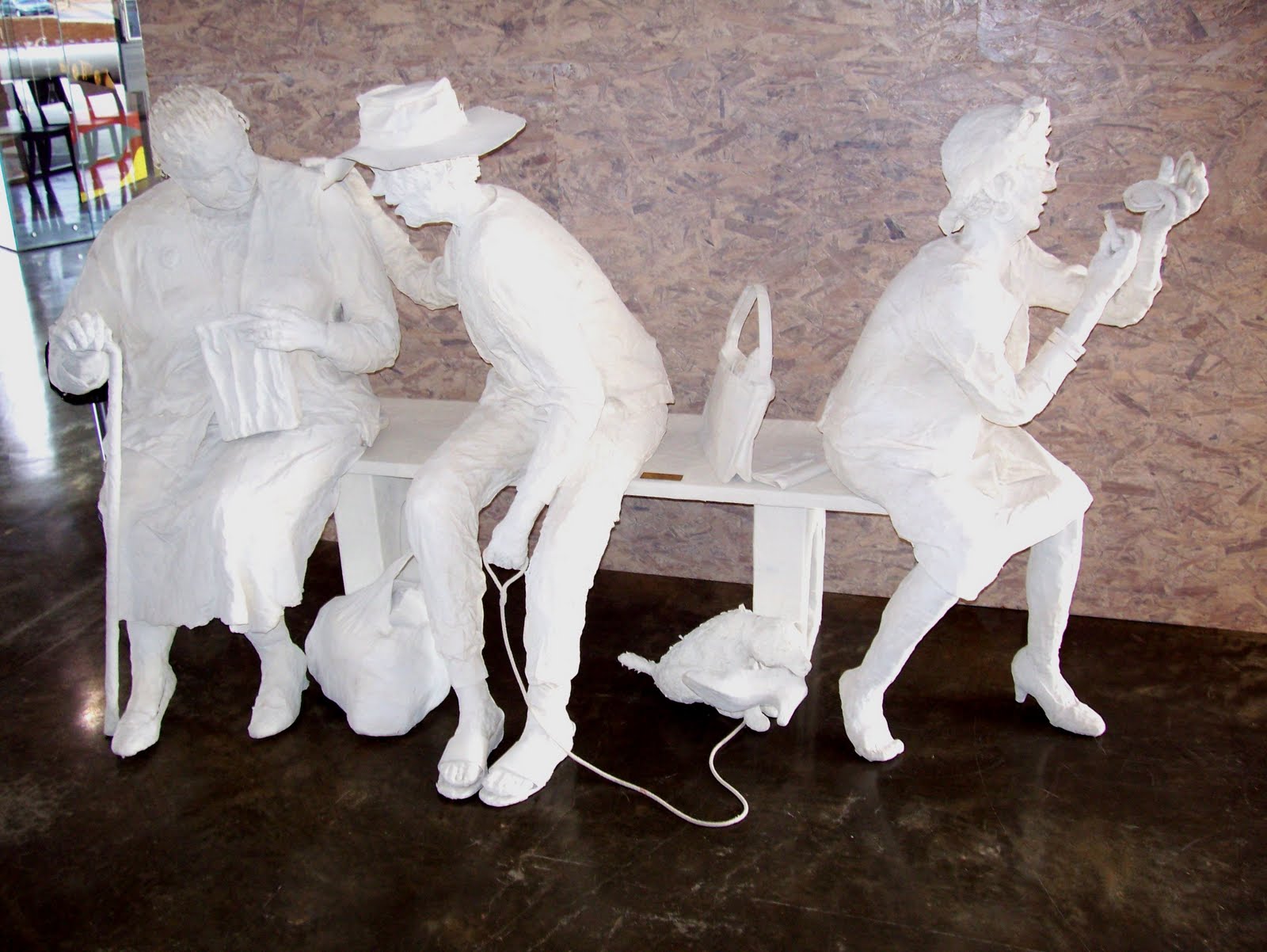
It is an interpretation centre, where enough information is available to whet the appetite of the visiting tourist, and it is the tourist it is aimed at as a marketing opportunity. It houses retailing of mementos, information about local crafts people, displays by these "Makers", the new home of Creative Paper, elements from the Pioneer Village Museum including the original Town Hall Clock in full working order, the Paper mache people, and as a major addition the first underground loader built by Dale B Elphinstone some 25 years ago just to name something of what you can expect to see. Included is the Visitor Information Centre manned by competent volunteers who can offer advise on what to see, and where to find it, plus other information on Tasmania in general.
So accept an invitation to come and have a browse through this new facility, you will be amazed at what is there.
Consider these calculations.
Total cost to the community of Burnie $850,000Assuming that Burnie has 9000 rate payers, cost to each rate payer = $94.44. Now let us go another step and calculate the cost to each member of the community, man woman and child. Burnie's population of 19000 in round figures = $44.74 per head of population. Now let me take you one step further and reduce the figure by $450,000 paid out by the insurance received from the fire in 2007, again in round figures divided by the 9000 rate payer = $44.44 each. Divide again by the number of citizen of the municipality = $21.04 per head of population. A small impost for a public asset.
Some members of the community say that it will never pay for itself. I have yet to see any community funded project ever pay for itself whether it be a Town Hall, Arts & Function Centre, or in this case the Makers Workshop, but it will most certainly will be a public asset, and one the people of Burnie can be justifiably proud of in the foreseeable future.
Quoted from the Burnie City Council media release 12th March 2009.
"BURNIE'S HISTORY HEART OF THE MAKERS WORKSHOP HUNDREDS of items showcasing Burnie s history are at the heart of the new Makers Workshop at West Park.With construction underway, the Burnie City Council s $5.35 million development will be one of the first of its kind in Australia.Project graphic designer David Lancashire has selected more than 200 items from the Pioneer Village Museum, which will support almost 40 stories depicting Burnie s history.Burnie Mayor Alvwyn Boyd said Mr Lancashire was amazed at the resources available and praised the Burnie community for its dedication to preserving its history. David said that there were very few communities that have done such a fantastic job of preserving its history, Mayor Boyd said.We have had and continue to have residents who go above and beyond the call of duty to showcase, protect and advance their city. Through the Makers Workshop, people just like this will be showcased and remembered through a significant collection of photos, objects and multi-media.The interpretative displays will come under eight major themes including Commerce and Industry, People and Pioneers, Global Connections, Agriculture and Environment, Innovators and Entrepreneurs, Paper and Paper Making, VDL Company and Port and the Pioneer Village Museum. Through these categories more than 40 different stories will be told.The facility will also have museum standard showcases and it is hoped that significant items from the State collection relating to Burnie s history can be sourced to form temporary exhibitions at the centre, Mayor Boyd said. He also said the facility would also provide locals and visitors with the unique opportunity of viewing the activity pods, which will act as studios for local artists.We've already had a number of local artists keen to get involved, Mayor Boyd said. "This will provide them with the opportunity to showcase their talents to a large, changing audience on a daily basis." There will also be paper-making activities, a gallery, café and a retail area, with the centre due for opening in October this year."
As a Volunteer at this new facility I can see nothing but benefits to the business houses of Burnie, tourism in the region, and dollars rolling in where the planners expected.
The Pioneer Village Museum Street Scape looks like getting a new lease of life (thank goodness) as this facility runs very close to the hearts and souls of the Citizens of Burnie. To see it closed would be equated to murder. It is the history of Burnie in the making from "Campsite to City" to quote the late Kerry Pink's book title. (If you haven't read it, ask for a copy of it from the Tasmanian State Library)


Lacos Cheese, and Hellyer Road Distillery, Emu valley Rhododendron Gardens, Ainsleigh Gardens, Guide Falls, The Alpaca farm at West Ridgley will all be beneficiaries of what we can offer in our beautiful little city. The cruise ship passengers can't all be wrong. We just do not appreciate what we have in our "Patch of Paradise".

Now a question for those of you who are going to visit the Makers Workshop.

What is the significance of the 127N on the wall, what does it stand for?

If you are a past employee of the APPM, Australian Paper, Paperlinx, or as it is now known as Tasmanian Paper and know the answer, please do not post a comment with its meaning.

It is interesting to note that the original underground loader is in pristine condition. I have been told on good authority that when Dale Elphinstone was asked if it could be put on display as is, he refused unless it was looking brand new. What you see is months of work by his tradesmen fitted with new tyres, sandblasted and resprayed with epoxy enamel, new lights and drivable. Such is the man and his machines. A true "Maker" of Burnie.


As can be seen in the photo, the kids just love it.

Artists and Crafts people featured:

Jan Marinos. Paper maker and textile artist.

Darren Simpson. Paper maker.

Dean Jupp. Paper maker.

The three above mentioned can be seen at Creative Paper's workshop.


Kit Hiller. Painter and Print maker. Some of Kit's work can be seen hanging in the complex.

Rick Eaves. Photographer - Image maker.

Obie. The master image maker.

Maria Perez-Pulido. Violin maker.

Greg Ling. Wood craftsman and instrument maker.

Pam Thorne & Ruth Rees. The Paper people makers. Look around you when you enter, their work will amaze you.
Janine Morris. Fibre artist and basket weaver.

Maudie Bryan. Glass artist and ceramic artist.

Anne Dunham. Glass artist and art teacher.

Mary Lewis. Glass bead maker.

Susanne McArthur, The Milliner. Hats and Fascinators for all occasions.
From time to time Artists will have the opportunity to display their work in the Makers Workshop area. An example of this was the Digital Painting exhibition of 19 year old Penguin artist Jessica Turale who's exhibition opened Friday evening of the 13th Of November 2009. A very talented young lady.


Now while you are in the Makers Workshop feel free to ask for travel advise, places of interest to visit, and accommodation in the Burnie area. The Volunteers are well trained to assist you in making the correct decisions that will make your stay in Burnie one to remember.


Now that you have been around the displays, it's time to sit and relax with a coffee of your choosing in the Cafe area. Consider sampling the fine locally made pastries, or perhaps something else on the ever changing menu, Having been served, view the sights from the deck or though the plate glass windows. The views will astound you, take advantage of what you see and take photo's to remind you of the time you spent at the Makers' Workshop

7th August 2011 Notation added:

For the past few months there was much talk of National Foods the owners of the "Lactos" Cheese factory on Surrey Road Burnie spending big dollars to upgrade their plant. This has now been confirmed, plans submitted to the Burnie City Council for building and enviromental approval. A part of the up grade is the eventual closing of the onsite Cheese Tasting and retail shop. So now negotiations are talking place to relocate to the only place it should go to - "The Makers' Workshop".

One can only hope it is up and running before the next Cruise Ship season beginning in October 2011. I'm sure that this will be an added attraction to what is becoming an icon of Burnie. Whether you love it or hate it (the building), it is what is in the heart of it that counts, the people who work as Makers, volunteers, and paid staff that counts.

Makers Workshop. 2 Bass Highway, Burnie, Tasmania. 7320


Explore the possibilities, we did and still are.

Monday, August 24, 2009

I don't think I've heard it better explained than this.

'Well you see, Norm, it's like this . . . A herd of buffalo can only move as fast as the slowest buffalo. And when the herd is hunted, it is the slowest and weakest ones at the back that are killed first. This natural selection is good for the herd as a whole, because the general speed and health of the whole group keeps improving by the regular killing of the weakest members. In much the same way, the human brain can only operate as fast as the slowest brain cells. Now, as we know, excessive intake of alcohol kills brain cells. But naturally, it attacks the slowest and weakest brain cells first. In this way, regular consumption of beer eliminates the weaker brain cells, making the brain a faster and more efficient machine. And that, Norm, is why you always feel smarter after a few beers.'
BUT DON'T DRIVE A CAR, THAT CAN BE FATAL!

Thursday, August 20, 2009

This needs no introduction

Go to this URL if you need the advice, genlemen be warned you are in danger.

Friday, August 7, 2009

THE PROGRESSION OF TEACHING MATHS AS TIMES CHANGE

TEACHING MATHS IN 1970 A logger sells a truckload of timber for $200. His cost of production is 4/5 of the price. What is his profit?

TEACHING MATHS IN 1980 A logger sells a truckload of timber for $200. His cost of production is 80% of the price. What is his profit?

TEACHING MATHS IN 1990 A forester sells a truckload of timber for $100. His cost of production is $160. How much was his profit?

TEACHING MATHS IN 2000 A forester sells a truckload of timber for $200. His cost of production is $160 and his profit is $40. Your assignment: Underline the number 40.

TEACHING MATHS IN 2005 A forester cuts down a beautiful native forest because he is selfish and inconsiderate and cares nothing for the habitat of animals or the preservation of our old growth forests. Your assignment: Discuss how the birds and possums might feel as the logger cut down their homes just for a measly profit of $40.

TEACHING MATHS IN 2009 A forester is arrested for trying to cut down a tree in case it may be offensive to Muslims or other religious groups not consulted in the felling license. He is also fined $200 as his chainsaw is in breach of Occupational Health and Safety legislation as it deemed too dangerous and could cut something or someone. He has used a chainsaw for over 20 years without incident however he does not have the correct certificate of competence and is therefore considered to be a recidivist and habitual criminal. His DNA is sampled and his details circulated throughout all government agencies. He protests and is taken to court and fined another $200 because he is such an easy target. When he is released he returns to find environmental protestors have cut down half his wood to build a camp on his land. He tries to throw them off but is arrested, prosecuted for harassing a minority group, imprisoned and fined a further $200. While he is in jail the environmental protestors cut down the rest of his wood and sold it on the open market for $200 cash. They also have on leaving a barbeque of possum and native hen and depart leaving behind several tonnes of rubbish and asbestos sheeting. The forester on release is warned that failure to clear the fly struck tipped rubbish immediately at his own cost is an offence. He complains and is arrested for environmental pollution, breach of the peace and invoiced $12,000 plus GST for safe disposal costs by a regulated government contractor. Your assignment: How many times is the forester going to have to be arrested and fined before he realises that he is never going to make $200 profit by hard work, give up, sign onto the dole and live off the state for the rest of his life?

TEACHING MATHS IN 2010 A forester doesn't sell a truck load of timber because he can't get a loan to buy a new truck because his bank has spent all his and their money on a derivative of securitised debt related to sub-prime mortgages in the USA and lost the lot with only some government money left to pay a few million dollar bonuses to their senior directors and the traders who made the biggest losses. The logger struggles to pay the $2400 road tax on his old truck however, as it was built in the 1970s it no longer meets the emissions regulations and he is forced to scrap it. Some Muslim loggers buy the truck from the scrap merchant and put it back on the road. They undercut everyone on price for haulage and send their cash back home, while claiming unemployment for themselves and their relatives. If questioned they speak no English and it is easier to deport them at the governments expense. Following their holiday back home they return to the Australia with different names and fresh girls to exploit and start again. The forester protests, is accused of being a bigoted racist and as his name is on the side of his old truck he is forced to pay $2,500 registration fees as a gang master. The Government borrows more money to pay more to the bankers as bonuses are not cheap. The parliamentarians feel they are missing out and claim the difference on expenses and allowances. Your assignment: You do the maths.

TEACHING MATHS 2017 أ المسجل تبيع حموله شاحنة من الخشب من اجل 100 دولار. صاحب تكلفة الانت=D 8ج من الثمن. ما هو الربح له؟

Thursday, August 6, 2009

Recipe for financial ruin - Guaranteed.

It is the month of August 2009, on the shores of the Black Sea . It has been raining, and the little town looks totally deserted. It is tough times, everybody is in debt, and everybody lives on credit.

Suddenly, a rich tourist comes to town. He enters the only hotel, lays a €100 [Euro] note on the reception counter, and goes to inspect the rooms upstairs in order to pick one.
The hotel proprietor takes the €100 note and runs to pay his debt to the butcher. The Butcher takes the €100 note and runs to pay his debt to the goat herder. The goat herder takes the €100 note and runs to pay his debt to the supplier of his feed and fuel. The supplier of feed and fuel takes the €100 Euro note and runs to pay his debt to the town prostitute that in these hard times gave her services on credit. The prostitute runs to the hotel and pays off her debt with the €100 Euro note to the hotel proprietor to pay for the rooms that she rented when she brought her clients there. The hotel proprietor then lays the €100 note back on the counter so that the rich tourist will not suspect anything.
At that moment, the rich tourist comes down after inspecting the rooms and takes his €100 note after saying that he did not like any of the rooms and leaves town.
No one earned anything. However, the whole town is now without debt and looks to the future with a lot of optimism.
And that, ladies and gentlemen, is how the United States Government is doing business today.
BELIEVE IT OR NOT!